
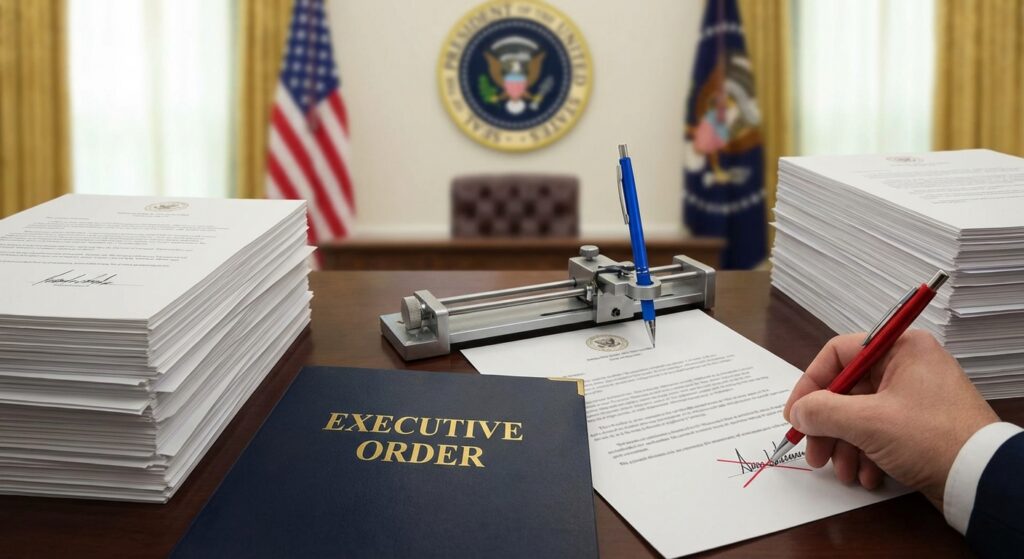
Trump Claims He Will Nullify Executive Orders Joe Biden Signed by Autopen
In a development capturing nationwide attention, former President Donald Trump has publicly declared his intention to nullify executive orders signed by President Joe Biden using an autopen device. The announcement, made within the last 24 hours, has sparked a flurry of reactions from political analysts, legal experts, and the broader public, raising questions about the legality and implications of such claims as the 2024 political landscape continues to evolve.
Related: Trump to Hold Venezuela Oval Office Meeting, Sources Say
Related: The Emerging MAGA Fractures: Understanding the Divisions Within a Political Movement
Related: The Next Big Battleground Test: A Wisconsin Race That Has Tortured Republicans
Understanding the Autopen and Its Use in Presidential Signatures
The autopen is a mechanical device used by presidents and government officials to replicate signatures, primarily for documents requiring prompt signing but not necessarily personal attention. While the use of an autopen is legally recognized for certain presidential documents, its application to executive orders has been less common and remains a subject of debate.
President Joe Biden reportedly utilized the autopen to sign some executive orders, a practice that has drawn scrutiny from critics who argue it may undermine the authenticity or intent behind such orders. Trump’s recent claim directly challenges the validity of these orders, asserting that they can be nullified on the basis of how they were signed.
Background: Executive Orders and Their Legal Standing
Executive orders are directives from the President that manage operations of the federal government. They carry the force of law but do not require congressional approval. Historically, presidential use of executive orders has been a strategic tool for implementing policy swiftly.
The legitimacy of executive orders hinges on the president’s constitutional authority. The method of signing, including the use of an autopen, generally does not influence their legal standing if the order complies with statutory and constitutional limits. However, Trump’s assertion calls this convention into question, potentially setting a precedent for future challenges to executive actions.
Trump’s Announcement: Political and Legal Implications
Trump’s claim to nullify Biden’s autopen-signed executive orders is unprecedented and carries significant political weight. It underscores ongoing tensions between the former and current administrations, highlighting a broader struggle over executive authority and legitimacy.
From a legal perspective, the claim raises several critical questions:
- Can a former president nullify executive orders issued by a sitting president? Traditionally, a former president has no legal authority to reverse executive orders.
- Does the use of an autopen affect the validity of executive orders? Legal experts generally agree that the method of signature has little bearing on the enforceability of an order, as long as it is properly authorized.
- What processes are necessary to rescind or modify executive orders? Typically, a sitting president issues a new executive order to amend or revoke previous ones.
Trump’s statement may be more political rhetoric aimed at energizing his base ahead of the 2024 election cycle, rather than a feasible legal strategy.
Expert Insights: Interpretation from Legal and Political Analysts
Experts from both legal and political spheres have weighed in on the situation. A common view is that while the autopen is a valid tool for presidential signature, the notion that it invalidates executive orders is weak from a constitutional standpoint.
Legal analysts emphasize that executive orders derive authority from the president’s constitutional powers, not the physical act of signing. A signature, whether manual or mechanized, primarily serves to document the order’s issuance.
Political commentators note that Trump’s claim may be part of a broader narrative to question the legitimacy of the current administration’s actions. Such tactics have been observed in recent election cycles where political messaging often blurs the lines between legal reality and public perception.
Possible Consumer and Public Impact
While the dispute over executive orders may seem distant from everyday life, executive orders often have direct consequences for citizens, impacting areas such as healthcare, environmental policy, immigration, and economic regulations.
Uncertainty about the validity of these orders could lead to confusion in federal agencies and among the public. For example, if certain policies are claimed to be invalidated prematurely, it may disrupt enforcement and compliance efforts, affecting service delivery and regulatory oversight.
Stakeholders across various industries and sectors will likely monitor the situation closely to anticipate changes that could affect operational or legal frameworks.
Contextualizing This Development Within the 2024 Political Climate
The timing of Trump’s declaration aligns with an intensifying 2024 election campaign season. As candidates vie for public support, disputes about executive authority and the legitimacy of presidential actions are expected to become focal points.
This announcement also reflects ongoing polarization in U.S. politics, where procedural norms and institutional practices are increasingly contested. The debate over autopen use and executive order validity is emblematic of deeper political and ideological divides.
Forward-Looking Analysis: What to Expect Next?
- Legal Challenges: While Trump himself cannot nullify executive orders, lawsuits or legislative actions could be pursued to challenge specific policies.
- Political Mobilization: The claim may energize political bases and influence voter sentiment in upcoming primaries and general elections.
- Administrative Responses: The Biden administration and federal agencies may issue clarifications or reaffirmations regarding the use of autopen and the validity of executive orders.
- Media and Public Discourse: The narrative around this claim will likely dominate news cycles, influencing public understanding of executive powers.
Expert Insights
Industry experts emphasize the importance of distinguishing between political statements and legal realities. They caution that while political rhetoric is a common feature of U.S. elections, it does not necessarily translate into actionable legal outcomes. The experts advise the public to seek information from credible sources and to monitor official communications from government agencies closely.
Moreover, constitutional scholars underscore that the executive branch’s operations depend on established protocols and checks and balances designed to prevent unilateral disruptions. The use of autopen, long accepted for certain presidential documents, is unlikely to be a valid basis for invalidating executive orders.
Conclusion
Donald Trump’s recent claim to nullify executive orders signed by Joe Biden using an autopen introduces a complex mix of legal uncertainty and political strategy into the current U.S. political environment. While the assertion raises important questions about executive authority and procedural norms, prevailing expert opinion suggests it lacks a legal foundation.
As the 2024 election cycle progresses, this development is likely to fuel ongoing debates about presidential powers and governance. For the public and stakeholders, understanding the distinction between political rhetoric and legal fact will be essential in navigating the evolving landscape.
Authorities and observers will continue to monitor how this claim influences policy implementation, administrative actions, and voter perceptions in the coming months.